 EN
EN

Walk into almost any arcade, Family Entertainment Center (FEC), shopping mall, cinema, or amusement venue, and you'll likely find a crowd gathered around claw machines. These machines have remained one of the most popular attractions in the amusement industry for decades, attracting children, teenagers, and adults alike.
At first glance, claw machines seem simple. Players control a mechanical claw, attempt to grab a prize, and hope it lands in the prize chute. However, behind this straightforward gameplay lies a sophisticated combination of engineering, software programming, operational strategy, and customer psychology.
This is why the question "How do claw machines work?" has become increasingly popular online. Some players want to understand why they rarely win. Arcade entrepreneurs want to know whether claw machines are profitable. Equipment buyers want to learn how win rates are configured and which machines deliver the best return on investment.
The reality is that claw machines are far more complex than most people realize. Understanding how they operate can help players improve their chances of winning, assist operators in maximizing revenue, and enable investors to make smarter purchasing decisions.
In this guide, we'll explore claw machine mechanics, payout systems, profitability strategies, supplier selection, and the business principles that make claw machines one of the most successful amusement products in the world.
What Is a Claw Machine?
A claw machine, also known as a crane machine, claw crane machine, or UFO catcher in some markets, is a coin-operated amusement machine that allows players to control a mechanical claw and attempt to win prizes.
While prize types vary, common options include:
- Plush toys
- Collectibles
- Keychains
- Blind boxes
- Electronics
- Licensed merchandise
- Capsule toys
Modern commercial claw machines can be found in a wide range of entertainment environments because they offer a unique combination of low operating costs, high customer engagement, and strong earning potential.
Unlike traditional arcade games that provide only entertainment value, claw machines add an additional layer of excitement through prize redemption. This combination encourages repeat play and significantly contributes to their profitability.
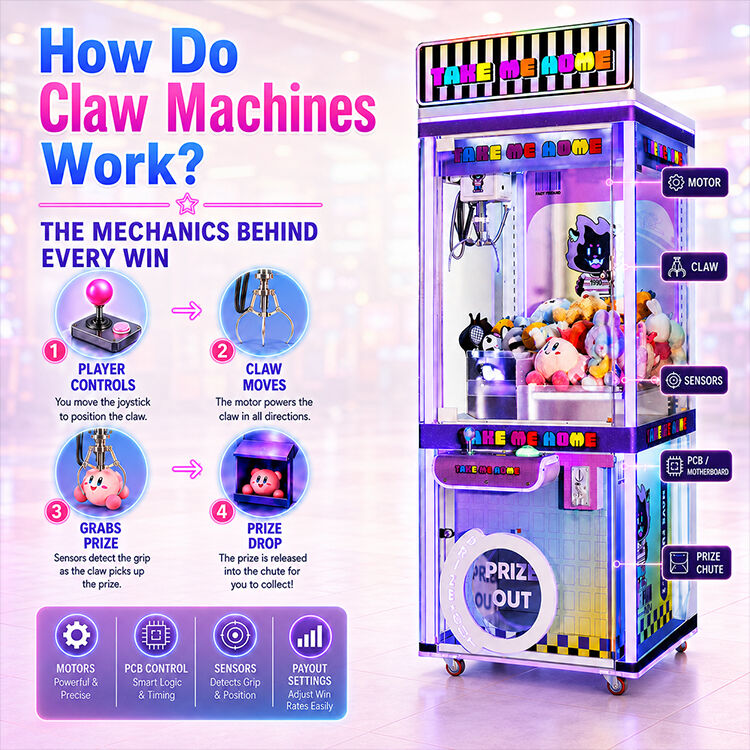
How Does a Claw Machine Work?
Although claw machines appear simple externally, they rely on multiple integrated systems working together.
When a player inserts money, tokens, or uses a game card, the machine activates and grants a limited period of control over the claw.
The process typically follows five steps:
Step 1: Player Positions the Claw
Using a joystick or directional buttons, the player moves the claw assembly into position above the desired prize.
Step 2: The Claw Drops
Once the player presses the action button, the claw begins descending toward the prize area using a motorized lifting system.
Step 3: The Claw Closes
When the claw reaches the programmed depth, the claw mechanism closes around the prize.
This stage is heavily influenced by claw strength settings programmed into the machine.
Step 4: The Claw Lifts and Travels
The claw lifts the selected prize and moves toward the prize chute.
Step 5: Prize Delivery
If the grip remains secure throughout the movement cycle, the claw releases the item into the prize chute, allowing the player to collect their prize.
Main Components of a Commercial Claw Machine
Understanding the internal structure helps explain how claw machines function and why certain machines perform better than others.
Component |
Function |
Main Control Board |
Controls machine settings and payout cycles |
X-Axis Motor |
Moves claw left and right |
Y-Axis Motor |
Moves claw forward and backward |
Z-Axis Motor |
Controls lowering and lifting |
Claw Coil System |
Opens and closes claw |
Power Supply |
Provides electrical power |
Coin Acceptor/Card Reader |
Handles payments |
Sensors |
Monitor claw position and movement |
Prize Detection System |
Tracks successful wins |
In modern commercial machines, most functions are managed through programmable software, allowing operators to adjust gameplay settings based on business objectives.
Are Claw Machines Rigged?
This is one of the most searched questions related to claw machines.
The short answer is no—but the complete answer is more nuanced.
Claw machines are generally designed around a combination of skill and programmed performance settings.
Player skill influences:
- Prize selection
- Positioning accuracy
- Timing
- Understanding prize shapes
However, software settings also affect results.
Most commercial claw machines allow operators to configure claw strength and payout frequency. This helps maintain a balance between customer satisfaction and operational profitability.
Without these controls, operators could lose money if prizes were too easy to win or discourage customers if winning became impossible.
The goal is not to prevent wins but to create a sustainable business model while maintaining an enjoyable customer experience.
How Do Operators Control Claw Machine Win Rates?
One of the most important aspects of claw machine operation is win rate management.
Modern commercial claw machines provide operators with adjustable settings that influence the likelihood of successful prize retrieval.
Claw Strength Settings
Most machines offer several strength levels:
- Strong Grip
- Medium Grip
- Weak Grip
Strong-grip cycles are typically programmed to occur at specific intervals based on the desired payout percentage.
Payout Programming
Operators often configure machines according to prize cost and revenue goals.
Example:
Prize Cost |
Recommended Win Rate |
$0.50 |
1 Win Every 8–10 Plays |
$1.00 |
1 Win Every 10–15 Plays |
$2.00 |
1 Win Every 15–20 Plays |
$5.00 |
1 Win Every 25–40 Plays |
These settings help maintain healthy margins while ensuring players continue experiencing regular wins.
Prize Placement
Prize arrangement also significantly impacts performance.
Well-positioned prizes encourage confidence and repeat play, while overcrowded prize bins often reduce player satisfaction.
Successful operators frequently adjust prize layouts to maintain customer engagement.
How Profitable Are Claw Machines?
For arcade entrepreneurs, profitability is often the most important question.
The good news is that claw machines consistently rank among the highest-performing attractions in many entertainment venues.
Several factors contribute to this success:
- Low electricity consumption
- Minimal staffing requirements
- Low maintenance costs
- High repeat-play behavior
- Flexible prize strategies
Average Monthly Revenue Per Machine
Actual performance varies by location, but industry averages often resemble the following:
Location Type |
Average Monthly Revenue |
Arcade Center |
$500–$2,000 |
Shopping Mall |
$1,000–$4,000 |
Cinema Lobby |
$800–$3,000 |
Supermarket |
$500–$1,500 |
Family Entertainment Center |
$1,500–$5,000+ |
Prime locations can significantly exceed these figures.
Operating Costs
Typical expenses include:
- Prize replenishment
- Electricity
- Maintenance
- Location rental (if applicable)
Compared to many arcade attractions, claw machines often deliver one of the lowest operating cost ratios.
Which Claw Machines Make the Most Money?
Not all claw machines generate the same level of revenue.
Different formats perform better in different environments.
Plush Toy Claw Machines
The most common and reliable option.
Advantages:
- Broad audience appeal
- Low prize costs
- Strong repeat play rates
Mini Claw Machines
Increasingly popular in shopping malls and retail locations.
Advantages:
- High space efficiency
- Lower startup investment
- Fast turnover
Multi-Player Claw Machines
Designed for competitive social play.
Advantages:
- Higher traffic attraction
- Increased group participation
- Strong social media appeal
Premium Prize Machines
Offer electronics, collectibles, and high-value items.
Advantages:
- Higher average spending
- Premium customer perception
Investment vs Revenue Comparison
Machine Type |
Investment Level |
Revenue Potential |
Plush Claw Machine |
Low |
High |
Mini Claw Machine |
Medium |
Very High |
Multi-Player Claw Machine |
High |
Very High |
Premium Prize Machine |
High |
High |
How to Choose a Claw Machine Supplier
For investors and arcade operators, selecting the right supplier can be just as important as selecting the right machine.
Several factors should be evaluated before purchasing.
Factory or Trading Company?
Working directly with manufacturers often provides:
- Better pricing
- Faster communication
- More customization options
- Direct technical support
Software Flexibility
A quality supplier should allow operators to adjust:
- Claw strength
- Payout settings
- Game duration
- Pricing
OEM and Branding Support
Customized branding can help operators create a distinctive customer experience and strengthen venue identity.
Spare Parts Availability
Reliable access to replacement parts helps minimize downtime and protect revenue.
Warranty and Technical Support
Commercial claw machines are long-term investments. Strong after-sales support is essential for maintaining operational performance.
EPARK has more than 14 years of experience manufacturing commercial claw machines and amusement equipment for arcades, Family Entertainment Centers, shopping malls, and entertainment venues worldwide. Through factory-direct production, OEM/ODM services, and customizable payout systems, operators can build claw machine businesses that align with their specific market requirements.
Real Claw Machine Business Example
Consider a shopping mall arcade operating twenty claw machines.
Project Overview
Location: Southeast Asia Shopping Mall
Machine Count: 20
Average Daily Plays Per Machine: 35
Average Price Per Play: $1
Estimated Monthly Revenue
20 Machines × 35 Plays × $1 × 30 Days
= $21,000 Monthly Gross Revenue
After prize replenishment and operational expenses, the venue achieved an estimated ROI period of approximately 10–12 months.
While actual results vary, this example demonstrates why claw machines continue to attract entrepreneurs seeking scalable entertainment business opportunities.
Why Claw Machines Remain a Smart Investment in 2026
As consumer preferences evolve, claw machines continue to maintain a unique position within the amusement industry.
They combine entertainment, prize redemption, social interaction, and psychological engagement in a format that appeals to virtually every age group. Their relatively low operating costs and flexible prize strategies allow operators to adapt quickly to changing market conditions.
For entrepreneurs looking to start an arcade business, expand a Family Entertainment Center, or add revenue-generating attractions to an existing venue, claw machines remain one of the most accessible and profitable investment opportunities available.
Conclusion
Claw machines are much more than simple prize games. Behind every play is a carefully designed system involving mechanical engineering, software programming, payout management, customer psychology, and business strategy.
For players, understanding claw machine mechanics can improve gameplay decisions. For operators, understanding win rates, prize costs, and machine configuration can significantly improve profitability. For investors, choosing the right machine and supplier can accelerate business growth and shorten ROI timelines.
Whether you're interested in claw machine mechanics, claw machine profitability, or launching your own claw machine business, understanding how these machines work is the first step toward making smarter decisions.
Table of Contents
- What Is a Claw Machine?
- How Does a Claw Machine Work?
- Main Components of a Commercial Claw Machine
- Are Claw Machines Rigged?
- How Do Operators Control Claw Machine Win Rates?
- How Profitable Are Claw Machines?
- Which Claw Machines Make the Most Money?
- How to Choose a Claw Machine Supplier
- Real Claw Machine Business Example
- Why Claw Machines Remain a Smart Investment in 2026