 EN
EN

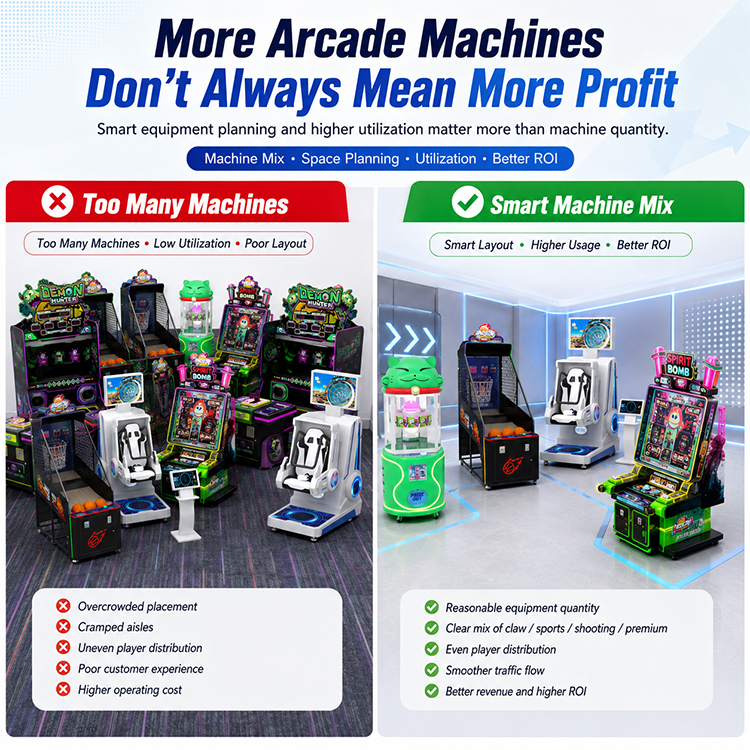
When opening or expanding an arcade business, one of the most obvious ideas is to add more arcade machines. More machines appear to mean more games, more choices, more players, and ultimately more revenue.
But the relationship between machine count and profit is not that simple.
An arcade with 50 machines does not automatically make more money than one with 30 machines. If half of those 50 machines are rarely played, they still consume valuable floor space, electricity, maintenance resources, and investment capital. Meanwhile, a smaller arcade with a carefully selected game mix may generate more revenue from each square meter.
For arcade operators, the real question should not be "How many machines can I fit into my venue?" but rather "How effectively is each machine contributing to the business?"
This is where machine utilization, revenue per machine, floor-space productivity, customer flow, game mix, operating costs, and return on investment become more important than machine count alone.
Revenue Is Not the Same as Profit
Adding arcade machines can certainly increase revenue opportunities. Every additional machine gives customers another reason to play and creates another potential source of income.
However, every machine also comes with costs.
An operator needs to consider the initial equipment investment, floor-space costs, electricity consumption, maintenance, spare parts, cleaning, payment systems, and staff resources. If a new machine generates $1,000 in additional monthly revenue but creates $800 in additional operating and ownership costs, the increase in revenue does not necessarily translate into an attractive improvement in profit.
This is why experienced operators look beyond gross sales.
They evaluate the incremental return created by each new machine.
A useful way to think about an arcade investment is to compare the additional revenue generated by a machine with the additional costs required to operate and maintain it. The stronger the difference, the more attractive the investment becomes.
The goal is not maximum equipment volume.
The goal is productive equipment.
Why Machine Utilization Matters More Than Machine Count
Machine utilization describes how actively a machine is being used during operating hours.
Consider two hypothetical arcades.
Arcade A has 50 machines, but many of them receive only occasional plays.
Arcade B has 30 machines, but the majority are consistently busy, particularly during peak hours.
Arcade B may have fewer machines but generate stronger revenue per machine and potentially better revenue per square meter.
This happens because customer demand is rarely distributed evenly across an arcade.
Some machines naturally attract attention because they are visually impressive, easy to understand, competitive, social, or connected to popular game mechanics. Others may have a narrow audience or become less attractive as customer preferences change.
Operators should therefore monitor machine-level performance rather than assuming every machine contributes equally.
Useful indicators include daily plays, revenue, average play frequency, maintenance costs, and repeat-play behavior.
Floor Space Is One of an Arcade Operator's Most Valuable Assets
An arcade machine does not only occupy the space covered by its cabinet.
A racing machine, for example, may require space around the machine for players to enter and exit. A shooting game may need additional standing space. Multiplayer games may attract groups that naturally occupy more room.
Operators also need walkways, queues, seating, prize areas, service access, and appropriate safety clearance.
This means that the true space requirement of a machine is larger than its physical footprint.
That makes revenue per square meter an important operating metric.
A machine that generates strong revenue while occupying a relatively small amount of productive floor space may be more valuable than a larger machine with impressive hardware but low customer utilization.
For this reason, arcade layout should be treated as a business decision, not simply an interior-design exercise.
The Right Game Mix Is More Important Than Having More Games
A profitable arcade needs variety, but variety does not mean randomly adding different machines.
A strong game mix should reflect the audience of the venue.
| Game Category | Main Customer Appeal | Business Role |
|---|---|---|
| Racing Games | Competition and excitement | Strong repeat play |
| Shooting Games | Fast-paced group play | Social entertainment |
| Redemption Games | Gameplay and prizes | Repeat visits |
| Sports Games | Familiar and accessible | Broad audience appeal |
| Claw Machines | Prize motivation | Impulse participation |
| Rhythm Games | Skill and performance | Younger audiences |
| VR & Simulators | Immersion | Premium experience |
Each category can serve a different purpose.
Racing games may attract competitive players. Redemption games can encourage repeat visits because players are motivated by prizes. Sports games are often easy for casual visitors to understand, while VR attractions can provide a more distinctive immersive experience.
The objective is to create a portfolio in which different machines support different customer needs.
If an arcade has too many machines that appeal to exactly the same type of player, the additional equipment may simply divide demand rather than create new demand.
Why Underperforming Machines Can Hurt Profitability
An underperforming arcade machine does more than generate low revenue.
It occupies space that could potentially be used by a stronger attraction.
It also consumes electricity, requires cleaning, may need maintenance, and contributes to the overall investment cost of the venue.
There is also a customer-experience issue.
A large arcade filled with machines that are rarely used can sometimes feel less energetic than a smaller venue where popular attractions are surrounded by active players. Entertainment environments depend heavily on visual and social energy.
This does not mean every machine needs to be constantly busy.
Some machines naturally have different utilization patterns.
However, consistently weak performance should trigger a review.
Operators should ask whether the problem comes from the machine itself, its location, pricing, game difficulty, customer demographics, or changing market preferences.
Replacing an underperforming machine may sometimes create more value than simply adding another machine elsewhere.
When Should an Operator Consider Replacing a Machine?
There is no universal number of days or months after which a machine should automatically be replaced.
Instead, operators should look for patterns.
A machine may deserve closer attention when it consistently has:
- Low daily play volume
- Weak revenue compared with similar machines
- High maintenance costs
- Low repeat-play behavior
- Poor visibility
- Outdated gameplay
- A weak connection with the venue's target customers
The important word is consistently.
A machine may perform poorly during weekdays but strongly on weekends. Another may become popular during school holidays. Operators should therefore evaluate performance across appropriate time periods rather than making decisions based on a single slow day.
Historical data is more useful than intuition alone.
Machine Placement Can Change Performance
A good arcade machine can perform poorly if it is placed in the wrong location.
Visibility matters.
Machines positioned near entrances or major customer-flow areas may attract more attention. Highly interactive games can also benefit from locations where other visitors can see the gameplay.
This creates a form of social proof.
When people see other customers enjoying a game, they may become curious and want to participate themselves.
Placement also affects complementary play.
For example, several redemption games located near a prize area may create a natural customer journey. Racing and competitive games may work well in another zone where groups can gather and watch each other play.
Operators should observe how customers actually move through the venue.
Sometimes the solution to a weak-performing machine is not replacement.
It is relocation.
Can Too Many Machines Make the Customer Experience Worse?
It may seem strange to suggest that more entertainment equipment could reduce the quality of an arcade.
But overcrowding can create several problems.
Too many machines can make walkways uncomfortable, reduce visibility between attractions, create excessive noise, and make it difficult for groups to move around. Customers may also find it harder to understand where they should go or which attractions are available.
A dense layout can therefore reduce the perceived quality of the venue even if it increases the number of machines.
This is particularly important for family-oriented locations.
Parents may want enough space for children to move safely. Groups may need room to gather around multiplayer attractions. Operators need service access for maintenance.
The best arcade layout balances equipment density with customer comfort.
More equipment is only useful when customers can actually enjoy it.
Pricing Also Affects Machine Profitability
Machine performance cannot be evaluated by play volume alone.
Pricing matters.
A machine receiving 100 plays at a lower price may generate less revenue than another machine receiving 70 plays at a higher price. At the same time, raising the price too aggressively can reduce customer participation.
This creates a balance between price, perceived value, and demand.
Operators may use different strategies depending on the venue, including standard per-play pricing, bundled credits, membership programs, promotional pricing, and peak or off-peak offers.
The right strategy depends on the target audience and local market.
There is no universal price that makes every arcade machine profitable.
Operators should instead test pricing and monitor how changes affect both revenue and customer behavior.
How to Measure Arcade Machine Performance
A professional arcade operation should have a way to compare machine performance.
| KPI | What It Tells You |
| Revenue per Machine | Direct financial contribution |
| Plays per Day | Customer engagement |
| Revenue per Square Meter | Space productivity |
| Utilization Rate | How actively equipment is used |
| Maintenance Cost | Operating burden |
| Repeat Play Rate | Replay potential |
| Payback Period | Investment recovery |
| Profit Contribution | Overall financial value |
These metrics should ideally be reviewed together.
For example, a machine may generate strong revenue but also have unusually high maintenance costs. Another may generate moderate revenue but require little maintenance and occupy limited space.
Looking at one number alone can therefore produce misleading conclusions.
The best-performing machine is not always the machine with the highest sales.
It may be the machine that creates the strongest overall return relative to its cost and space requirement.
When Does Adding More Machines Make Sense?
The argument is not that arcade operators should stop buying machines.
Expansion can be an excellent strategy when demand supports it.
Adding machines may make sense when existing attractions regularly have queues, productive floor space is available, customer demand exceeds current capacity, or the venue wants to introduce a new category of entertainment.
For example, if a venue consistently has customers waiting to use its racing games, adding another popular racing attraction could capture demand that is currently being lost to waiting time.
Similarly, if an arcade has strong demand from teenagers but very few immersive attractions, adding a VR or simulator experience may broaden the game mix.
The important point is that the new machine should have a clear business purpose.
Buy because there is demand—not simply because there is empty space.
A Better Strategy: Measure, Remove, Replace, Then Expand
For operators trying to improve profitability, a practical approach is to follow four steps.
1. Measure
Collect machine-level information on revenue, plays, utilization, maintenance, and customer behavior.
2. Remove
Identify machines that consistently underperform and determine whether their weak results are structural or temporary.
3. Replace
Use stronger-performing categories or new attractions to improve the overall game mix.
4. Expand
Once the venue demonstrates strong utilization and sufficient customer demand, consider adding more machines.
This sequence reduces the risk of expanding an inefficient business model.
It also turns machine investment into a continuous optimization process.
The Real Goal Is Profit per Square Meter
Arcade operators have several limited resources.
Capital is limited.
Floor space is limited.
Customer attention is limited.
Operating hours are limited.
Staff time is limited.
A successful arcade uses these resources efficiently.
That is why profit per square meter can be more meaningful than machine count. Two venues with the same floor area may have completely different financial performance because their layouts, game mixes, pricing, customer demographics, and machine utilization are different.
A smaller arcade with high-performing attractions can potentially outperform a larger arcade filled with low-demand equipment.
The question is not how much equipment the venue contains.
The question is how much value the equipment creates.
Conclusion
More arcade machines do not always mean more profit.
Additional equipment can increase revenue opportunities, but it also requires more capital, space, electricity, maintenance, and operational resources. If customer demand does not increase at the same rate, adding machines can dilute utilization and reduce the productivity of the venue.
For arcade owners, the smarter strategy is to focus on machine performance rather than machine quantity.
Track revenue per machine. Monitor utilization. Evaluate revenue per square meter. Review maintenance costs. Study customer flow. Build a balanced game mix and replace consistently underperforming attractions when necessary.
Expansion should come after optimization, not before it.
The strongest arcade is not necessarily the one with the most machines. It is the one where the right games are placed in the right locations, priced appropriately, and matched to the customers who actually visit the venue.
That is where machine investment becomes a business strategy rather than simply an equipment purchase.
Table of Contents
- Revenue Is Not the Same as Profit
- Why Machine Utilization Matters More Than Machine Count
- Floor Space Is One of an Arcade Operator's Most Valuable Assets
- The Right Game Mix Is More Important Than Having More Games
- Why Underperforming Machines Can Hurt Profitability
- When Should an Operator Consider Replacing a Machine?
- Machine Placement Can Change Performance
- Can Too Many Machines Make the Customer Experience Worse?
- Pricing Also Affects Machine Profitability
- How to Measure Arcade Machine Performance
- When Does Adding More Machines Make Sense?
- A Better Strategy: Measure, Remove, Replace, Then Expand
- The Real Goal Is Profit per Square Meter
- Conclusion