 EN
EN

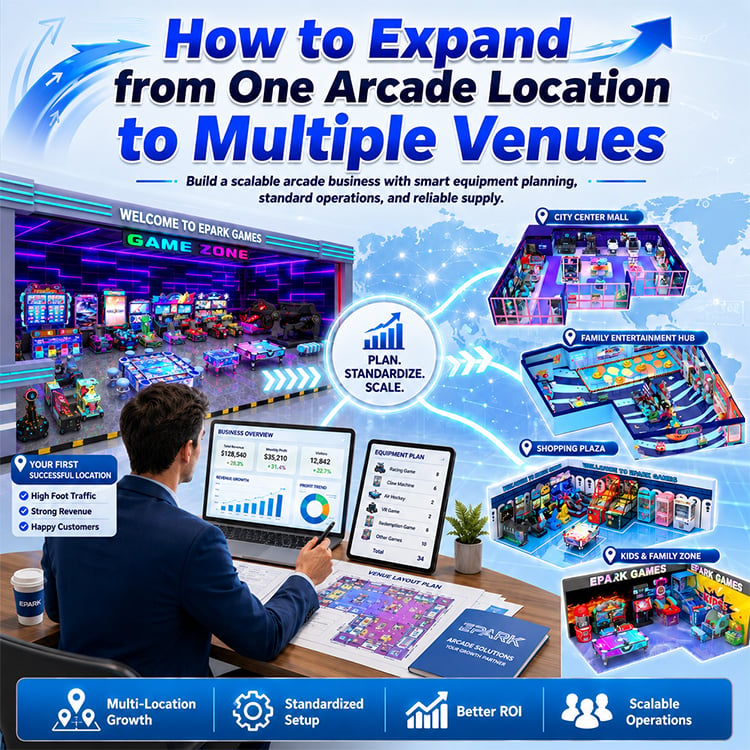
Opening your first successful arcade is a major achievement, but expanding from one location to multiple venues is an entirely different challenge. Many business owners assume that if one arcade performs well, opening a second or third location will automatically lead to greater profits. In reality, multi-location expansion requires a different mindset, stronger management systems, and careful financial planning.
The biggest mistake many operators make is trying to duplicate their first venue without understanding why it succeeded. Was it the location, the game mix, the marketing strategy, or simply the owner's daily involvement? Unless these factors are clearly identified and transformed into repeatable systems, expansion can quickly become difficult to manage.
Successful arcade chains are built on standardized operations, data-driven decisions, and consistent customer experiences. Instead of relying on one outstanding location, they create business models that can be replicated across different cities and markets.
In this guide, we'll explore how to determine whether your business is ready for expansion, how to choose the right locations, and how to build a scalable arcade business that continues to grow profitably.
Is Your First Arcade Ready for Expansion?
Before searching for a second venue, evaluate whether your first location is truly ready for growth.
Many operators expand too early because revenue appears strong during weekends or holiday seasons. However, expansion decisions should be based on long-term operational stability rather than short-term success.
Ask yourself these questions:
- Has the business been consistently profitable for at least 12 months?
- Can the venue operate smoothly without your constant presence?
- Are customer numbers stable throughout the year?
- Is cash flow sufficient to support expansion?
- Have operating procedures been standardized?
If the answer to several of these questions is "no," focusing on improving the existing venue may deliver better returns than opening another location.
Measure the Right KPIs
Expansion decisions should rely on measurable business performance rather than intuition.
Some of the most important KPIs include:
KPI |
Why It Matters |
Revenue per square meter |
Measures space efficiency |
Revenue per machine |
Identifies top-performing equipment |
Average customer spending |
Indicates customer value |
Repeat visit rate |
Reflects customer loyalty |
Equipment uptime |
Shows operational reliability |
Labor cost percentage |
Measures staffing efficiency |
Operating margin |
Determines overall profitability |
These indicators help determine whether your business model is strong enough to succeed in additional locations.
Understand What Drives Your Success
Before replicating your business, identify the factors behind your current performance.
For example:
- Is your location inside a high-traffic shopping mall?
- Does your prize strategy encourage repeat visits?
- Are certain machines responsible for a large percentage of revenue?
- Does excellent customer service differentiate your venue?
Understanding these strengths allows you to reproduce them intentionally instead of relying on luck.
Build Systems Before You Build More Locations
One of the biggest differences between a single-location operator and a multi-location business is the presence of standardized operating systems.
Without documented procedures, every new venue becomes increasingly dependent on the owner's personal involvement.
Create Standard Operating Procedures
Every daily task should follow a consistent process.
Examples include:
- Opening and closing procedures
- Machine inspection schedules
- Cleaning standards
- Cash handling
- Ticket and prize inventory management
- Customer complaint resolution
- Emergency response procedures
Written SOPs improve consistency while making employee training significantly easier.
Centralize Business Management
Managing multiple venues manually becomes increasingly difficult as the business grows.
Modern arcade businesses benefit from centralized systems that monitor operations across all locations.
Examples include:
- Cashless payment systems
- POS reporting
- Membership databases
- Machine performance dashboards
- Financial reporting
- Inventory management software
Having access to real-time business data allows owners to identify problems before they affect profitability.
Reduce Dependence on the Owner
A business cannot scale if every important decision depends on one person.
Successful operators gradually delegate responsibilities by training venue managers to oversee:
- Daily operations
- Staff scheduling
- Customer service
- Basic equipment maintenance
- Financial reporting
When managers can operate independently, owners gain more time to focus on expansion rather than daily operations.
Choose the Right Expansion Strategy
There is no single expansion model that fits every business.
The right approach depends on available capital, management experience, and long-term objectives.
Company-Owned Locations
This model provides maximum operational control.
Advantages include:
- Consistent customer experience
- Unified management
- Higher long-term profitability
- Better brand control
However, company-owned expansion also requires significantly more investment and management resources.
Joint Venture Partnerships
Some operators expand by partnering with local investors.
Benefits include:
- Shared investment
- Local market knowledge
- Reduced financial risk
The downside is that decision-making becomes more complex, and profit sharing must be clearly defined.
Smaller Satellite Arcades
Instead of opening another large Family Entertainment Center, many operators begin with compact arcade locations inside shopping malls, cinemas, or commercial complexes.
These venues require:
- Lower rent
- Smaller equipment investment
- Fewer employees
Satellite locations can serve as effective test markets before making larger investments.
Choosing the Right Location
A successful first venue does not guarantee success in every city.
Each market has different customer demographics, spending habits, and competitive conditions.
When evaluating a new location, consider:
Population Demographics
Look for areas with:
- Growing residential communities
- Young families
- High population density
- Strong disposable income
These characteristics often support long-term customer demand.
Foot Traffic
Shopping malls remain one of the most popular locations for arcade businesses because they generate consistent visitor traffic.
Evaluate:
- Daily visitor numbers
- Weekend traffic
- Nearby anchor tenants
- Cinema presence
- Food court activity
Higher traffic generally creates more opportunities to attract walk-in customers.
Local Competition
Competition should not automatically discourage investment.
Instead, study competing venues carefully.
Analyze:
- Machine selection
- Pricing strategies
- Customer reviews
- Strengths
- Weaknesses
Sometimes a better-operated arcade can outperform established competitors.
Occupancy Costs
Rent is only one part of total operating expenses.
Also calculate:
- Service charges
- Utilities
- Maintenance
- Insurance
- Marketing
- Staffing
A location with slightly higher rent but significantly stronger customer traffic may ultimately produce better returns.
Plan Your Expansion Budget Carefully
Opening a second location requires much more than purchasing additional arcade machines.
A realistic investment budget should include:
- Lease deposits
- Interior construction
- Commercial arcade equipment
- Redemption system
- Initial prize inventory
- Staff recruitment
- Employee training
- Marketing before opening
Working capital for the first several months
One of the most common expansion mistakes is investing nearly all available cash into the new venue while leaving the original location financially vulnerable.
Maintaining healthy cash reserves allows both locations to operate smoothly during unexpected challenges or slower-than-expected sales.
Standardize Your Equipment Mix Without Copying It Exactly
One of the biggest mistakes operators make when opening a second arcade is purchasing exactly the same machines as their first location. While your best-performing games should certainly be part of the new venue, every market has different customer preferences, demographics, and spending habits.
Instead of duplicating your existing arcade, create a core equipment strategy that can be adapted to each location.
For example, your core lineup might include:
- Claw machines
- Redemption games
- Basketball arcade games
- Racing simulators
- Air hockey
- Kiddie rides
These categories consistently perform well in most commercial entertainment venues. However, the number of machines in each category should vary depending on the venue size and customer profile.
A shopping mall with a high percentage of young families may require more kiddie attractions and redemption games, while a downtown entertainment center targeting teenagers and young adults may benefit from larger racing simulators and competitive sports games.
Successful expansion is about repeating a proven business model—not creating identical venues.
Use Data to Optimize Every Location
As your business grows, every machine should justify the space it occupies.
Track key performance indicators for each game, including:
- Revenue per machine
- Revenue per square meter
- Average daily plays
- Maintenance frequency
- Downtime
- Prize payout ratio (for redemption games)
- Return on investment (ROI)
Comparing these metrics across locations helps identify which machines deserve expansion and which should be replaced.
Many successful arcade operators review machine performance monthly rather than waiting until annual budgeting.
Data-driven decisions lead to more profitable venues over time.
Build a Strong Management Team
No business can successfully operate multiple locations if every decision depends on the owner.
As you expand, your management structure becomes just as important as your equipment investment.
Hire Capable Venue Managers
Each location should have a manager responsible for:
- Daily operations
- Staff scheduling
- Customer service
- Cash control
- Basic equipment coordination
- Sales reporting
Rather than solving every problem yourself, empower managers to make operational decisions within clearly defined guidelines.
Invest in Employee Training
Consistent training ensures customers receive the same quality experience regardless of which location they visit.
Training programs should include:
- Customer service standards
- Machine operation
- Safety procedures
- Cleaning routines
- Prize counter management
- Upselling birthday packages and memberships
Well-trained employees improve customer satisfaction while reducing operational mistakes.
Prepare Future Leaders
If your goal is to operate five or ten locations, today's venue managers may become tomorrow's regional managers.
Develop internal promotion opportunities by providing leadership training and performance evaluations.
Building leadership from within often produces better long-term results than hiring external managers unfamiliar with your business.
Maintain a Consistent Brand Experience
Customers should immediately recognize your business regardless of which location they visit.
Consistency builds trust and strengthens brand recognition.
Standardize elements such as:
- Logo and signage
- Interior design
- Staff uniforms
- Customer service standards
- Membership programs
- Pricing structure
- Redemption systems
- Promotional materials
However, consistency does not mean every venue must look identical.
Allow flexibility for local customer preferences, seasonal events, and venue size while maintaining your core brand identity.
Centralize Marketing and Customer Retention
Marketing becomes far more effective when managed across all locations rather than independently.
Build One Membership System
A unified membership program allows customers to earn and redeem points at every venue.
Benefits include:
Greater customer convenience
Increased repeat visits
Better customer data
Cross-location promotions
If customers move between different shopping malls or cities, they remain connected to your brand.
Run Local and National Promotions
Combine company-wide campaigns with local marketing initiatives.
Examples include:
Grand opening events
Holiday promotions
School vacation activities
Birthday party packages
Double-ticket redemption days
Tournament competitions
This approach strengthens brand awareness while allowing each location to respond to local market opportunities.
Monitor Customer Acquisition Costs
As your marketing budget grows, measuring return on investment becomes increasingly important.
Track:
Cost per new customer
Repeat customer rate
Customer lifetime value
Membership growth
Digital advertising performance
Understanding these metrics helps allocate marketing resources more effectively.
Common Expansion Mistakes
Many arcade businesses struggle during expansion—not because demand is weak, but because growth happens faster than management systems can support.
Avoid these common mistakes:
Expanding Too Early
Opening another venue before the first operates consistently can place unnecessary financial pressure on the business.
Ignoring Local Market Differences
Every community has unique customer demographics and entertainment preferences.
Never assume one successful game mix will work everywhere.
Underestimating Working Capital
Many new locations require several months to reach stable profitability.
Ensure sufficient cash reserves are available during this period.
Hiring Too Quickly
Rapid recruitment without proper training often leads to inconsistent customer experiences.
Invest in people before expanding aggressively.
Focusing Only on Revenue
Higher sales do not always mean higher profits.
Monitor expenses, labor efficiency, machine performance, and operating margins alongside revenue growth.
A Practical Roadmap for Multi-Location Expansion
Stage |
Objective |
Key Action |
1 |
Strengthen your first venue |
Achieve consistent profitability and stable operations |
2 |
Standardize systems |
Document procedures and train managers |
3 |
Research new markets |
Analyze demographics, traffic, and competition |
4 |
Prepare investment |
Calculate total costs, cash flow, and ROI |
5 |
Open the second venue |
Launch with a balanced equipment mix and targeted marketing |
6 |
Monitor performance |
Compare KPIs across all locations and optimize operations |
7 |
Scale strategically |
Expand only after systems prove repeatable |
Following a structured roadmap reduces operational risk and helps create sustainable long-term growth.
Conclusion
Expanding from one arcade location to multiple venues is about far more than opening additional stores. It requires transforming a successful single business into a scalable organization built on standardized systems, reliable data, and capable leadership.
Before opening a second venue, ensure your first location demonstrates consistent profitability, documented operating procedures, and a management team that can function independently. Expansion should strengthen your business—not stretch it beyond its capabilities.
The most successful multi-location operators don't simply replicate their first arcade. They analyze local markets, adapt their equipment mix, centralize management, and continuously improve performance using measurable KPIs.
With careful planning, disciplined financial management, and a long-term vision, expanding to multiple locations can create new revenue opportunities while building a stronger and more recognizable entertainment brand.
Table of Contents
- Is Your First Arcade Ready for Expansion?
- Choose the Right Expansion Strategy
- Choosing the Right Location
- Plan Your Expansion Budget Carefully
- Standardize Your Equipment Mix Without Copying It Exactly
- Build a Strong Management Team
- Maintain a Consistent Brand Experience
- Centralize Marketing and Customer Retention